
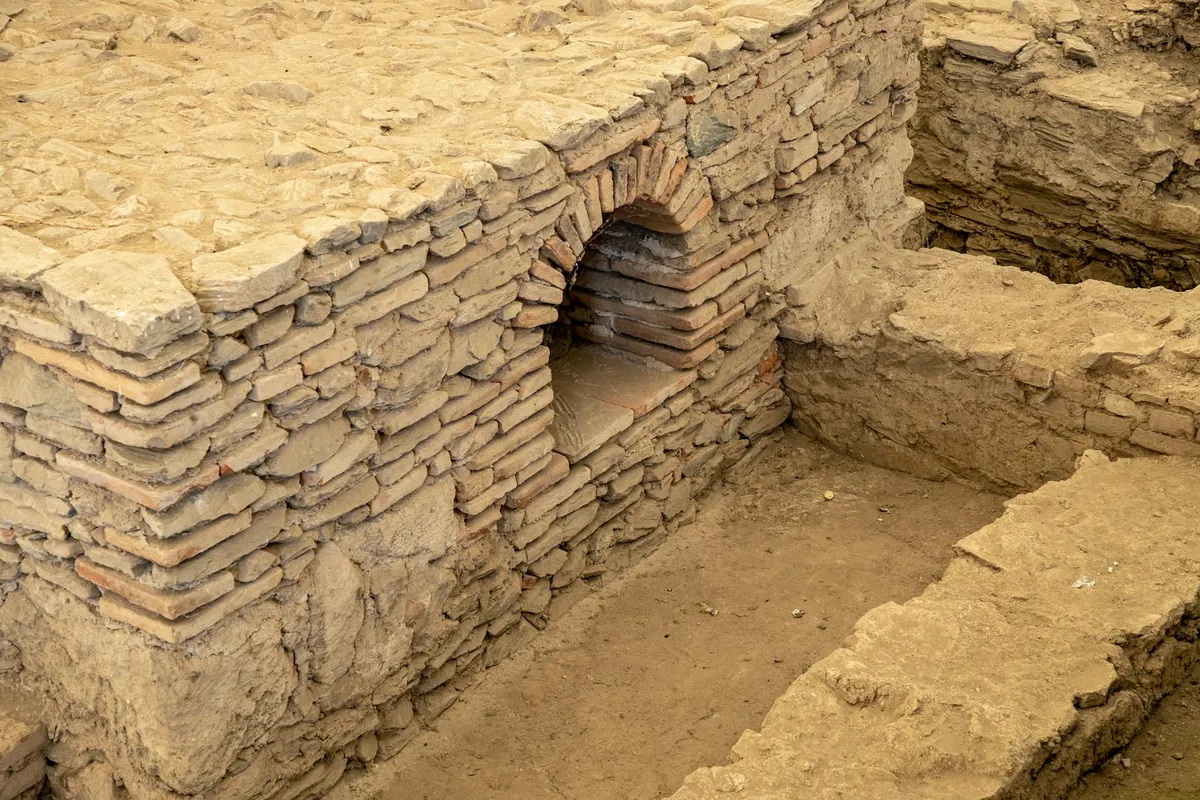
Most cities are built on top of older cities. The ground beneath modern streets contains the foundations of buildings that have been demolished, the streets that have been buried, the structures of cultures that occupied the same locations centuries or millennia earlier. The layers are usually invisible — paved over, built upon, forgotten. The cities that preserve visible layers are the exceptions; even those cities reveal only fragments of what's actually beneath them.
This essay is about the layers beneath city streets. What they contain, what they teach about urban continuity, and the rare cities where they're visible.
Why cities accumulate layers
The fundamental reason cities are built on cities: location matters. Cities form where rivers can be crossed, where harbors are protected, where roads converge, where defensible positions exist. These location advantages persist across centuries; the cultures that occupy them change. Each successive culture builds on what came before.
The new construction usually doesn't demolish completely. Foundations get reused. Walls get incorporated into new structures. Streets follow existing paths. The accumulation builds vertically as well as laterally. The ground level rises over centuries as construction debris, ash, garbage, and natural deposits build up.
The ground level of a city in 2026 is often several meters above the ground level of the same city in Roman times. The Roman city is still there, beneath the modern surface, sometimes accessible through excavation, often only theoretically present in archaeological knowledge.
What the layers contain
Archaeological excavation in continuously-occupied cities reveals consistent patterns:
Foundations of demolished buildings. The walls and floors of structures that no longer exist, sometimes incorporated into newer buildings, sometimes buried under later construction.
Buried streets. The street networks of earlier periods, often following different paths than modern streets but sometimes following remarkably similar ones.
Infrastructure remains. Roman aqueducts and sewers, medieval wells, early water systems, electrical and gas infrastructure that's been replaced.
Domestic remains. Pottery, household objects, food remains, the artifacts of daily life across the various occupation periods.
Burial sites. Cemeteries that have been built over, individual burials in church floors, mass burials from plague and war periods.
Industrial remains. Workshops, kilns, mills, factories — the industrial activity that supported each city in each period.
The accumulation in major cities is enormous. Rome's archaeological layers go down 7-12 meters in central areas, with continuous occupation across roughly 2,500 years. Istanbul, Athens, Damascus, and other ancient cities have similar depth.
Cities where the layers are visible
A small number of cities have made the archaeological layers visible to ordinary residents and visitors. The visible layers transform the experience of the city for people who engage with them.
Rome. The exposed Roman ruins, the medieval churches built on Roman foundations, the basement-level archaeological sites accessible from modern streets. Walking through Rome can be a continuous experience of the layered city.
Athens. The Acropolis and surrounding archaeological zones, the Byzantine churches integrated with classical remains, the modern city built around and through the ancient one.
Istanbul. The Roman cisterns, the Byzantine walls, the Ottoman buildings, the modern city — multiple layers visible in many neighborhoods.
Mexico City. The Aztec Templo Mayor visible alongside Spanish colonial buildings and modern construction. The layers of the conquest physically present.
Jerusalem. Multiple religious traditions overlaid in continuous occupation across millennia, with archaeological layers accessible at many points.
These cities are exceptional. Most cities with comparable archaeological depth have buried their layers under modern construction without making them accessible.
What the visible layers offer
Cities where the layers are visible offer something that other cities cannot: a continuous awareness of the deep time of urban occupation. Walking through Rome, the visitor encounters Roman, medieval, Renaissance, baroque, and modern construction continuously. The temporal layering is part of the experience.
This produces several effects:
Awareness of urban continuity. The city has been a city for two and a half millennia. The current residents are part of an unbroken sequence. The current concerns about the city are continuations of concerns that have been managed across many centuries.
Humility about the present. Whatever the current generation builds will become a layer for future generations. The current concerns will be subsumed by future concerns. The perspective produces less attachment to current arrangements than purely-modern cities encourage.
Engagement with historical traditions. The visible layers connect residents to historical traditions that purely-modern cities can only abstractly reference. The traditions become physically present rather than purely intellectual.
Different understanding of preservation. Cities with visible layers have learned that preservation isn't just about freezing one period; it's about accommodating multiple periods simultaneously. The accommodation produces richer urban texture than single-period preservation.
What other cities miss
Cities without visible layers — including most modern American cities, many Asian cities, much of post-war European reconstruction — exist in a relatively flat present tense. The history that exists is conceptual rather than physical. The depth of time is not available through walking.
This isn't a complete loss. These cities have other qualities — newness, organization, efficiency, the ability to address current concerns without inheritance constraints. The trade-offs are real on both sides.
What the cities without visible layers miss is specifically the experience of time made physical. The time exists in books and museums; it doesn't exist in the streets. Residents can know about the history without encountering it daily.
The layers beneath modern construction
Even cities without exposed layers have layers beneath them. The modern city is the most-visible level of an accumulation that extends down through earlier periods.
Construction projects in older cities frequently encounter the buried layers. Subway construction in Rome, Istanbul, Athens, and other ancient cities routinely involves archaeological investigation that delays the construction. The archaeology often produces discoveries; sometimes the construction proceeds; sometimes the archaeology causes the construction to be modified or abandoned.
The discoveries from construction archaeology have been substantial. The work continues to refine understanding of the historical layers in cities that have been studied for centuries.
The case for visibility
Cities considering whether to make their archaeological layers more visible face trade-offs. Visible archaeology constrains modern development. The investment in interpretation and access is substantial. Some discovered remains are difficult to incorporate into modern urban fabric.
The benefits, where successful: enhanced cultural identity, tourism appeal, educational value, connection between current residents and the deep history of their place.
The cities that have made significant investment in archaeological visibility — Rome, Athens, Istanbul, Mexico City, Jerusalem, others — have generally been rewarded for the investment. The visible layers become part of what defines the cities.
How to engage with layered cities
For visitors and residents of cities with visible layers, several practices enhance the experience:
Look down as well as up. The interesting things in layered cities are often beneath ground level. Many cities have basement-accessible archaeological sites that are easy to visit but rarely visited.
Read about the layers before visiting. The layers reveal more when the viewer understands what they're looking at. Pre-visit reading transforms the on-site experience.
Visit the smaller archaeological sites. The famous archaeological zones (Forum Romanum, Acropolis) are crowded and curated. Smaller sites often offer more-direct engagement with the historical layers.
Notice the integration into modern fabric. Some of the most-interesting archaeological remains are integrated into still-functioning buildings. The integration tells the story of how the layers actually relate.
Allow time. Layered cities reward slow attention. Quick visits miss most of what makes the layered cities distinctive.
The closing observation
The layers beneath city streets contain the deep histories of urban civilization. Most cities have buried their layers under modern construction; a few have made theirs visible. The cities with visible layers offer experiences that purely-modern cities cannot replicate.
For visitors interested in deep urban history, the layered cities are uniquely rewarding. For residents of those cities, the layers are part of what makes the cities specifically themselves rather than generic urban places.
The layers reward attention. They're mostly there for those willing to look — beneath the visible surfaces, in the integrations between old and new, in the awareness that what we see is the most-recent layer of an accumulation that extends down for centuries or millennia.
The cities are older than they appear. The history is closer to the surface than the modern-looking streets suggest.